
For most kids who attend Middletown Township Public Schools, school is just school. You get on the bus, you go to class, and see your friends—that’s the way it has always been—but this assumption became a lot harder to hold onto this past February.
On February 26, 2026, the Middletown Township Board of Education voted 5 to 4 to close two of its elementary schools, Leonardo Elementary and Navesink Elementary, effective at the end of the school year. The decision came after months of community debate, a failed attempt to do the same thing just one year earlier, and hours of emotional public testimony on the night of the vote itself.
When the decision was made, hundreds of Monmouth County families were left facing a September that will look nothing like the one they had planned for. Still, the closures are not final yet. A group of parents has already filed a 206-page legal appeal with the New Jersey Commissioner of Education, asking the state to intervene before the 2026-2027 school year begins. The outcome of that appeal—and a budget process that runs through May—will determine whether this decision holds or gets reversed
A Crisis Fifteen Years in the Making
To understand how Middletown Township got to that controversial decision you have to look as far back as 2009. Since 2009, the district has received roughly $7 million less per year in state aid than it once did. Compounded overtime, that’s more than $60 million lost in funding. Meanwhile, enrollment across the district has steadily decreased, leaving the district paying to heat, staff, and maintain buildings that are less full than they used to be. By Early 2025, the board was faced with a $10 million budget gap and could no longer look away. Superintendent Jessica Alfone unveiled a plan called “Middletown Reimagined,” which proposed closing Leonardo Elementary, Navesink Elementary, and transforming Bayshore Middle School into an elementary school in one swapping restructuring. This plan faced immense backlash. Parents organized under the banner of “Save our Schools” showed out in force, and armed themselves with their own financial data and enrollment projections to challenge the district’s numbers.
This iteration of the redistricting plan failed to get a majority vote, and instead the district passed a 10.1% school tax increase to plug the funding gap for that year. But Superintendent Alfone was clear: the tax hike was a one-year fix, not a long term solution. She warned the school closures were never fully off the table. She was right.
The Second Vote
By the time February 26, 2026 arrived, the district was projecting a $3.2 million deficit for the coming school year, one that would balloon to $6.6 million the year after, $10.2 million the next, and nearly $14 million by 2029-2030, putting the district in the same—if not worse—situation faced in 2025. Officials argued that closing the two elementary schools would save between $3.7 million and $4 million annually, and that the longer the district waited, the worse the situation would become. A revised plan for rezoning was needed.
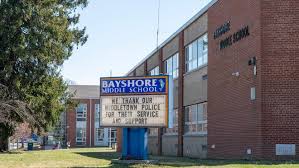
The revised plan looked like this: Leonardo and Navesink elementary students would be consolidated into the existing Bayshore Middle School Building, which would be renamed Bayshore Elementary. The current Bayshore middle schoolers would be rezoned to Thorne and Thompson middle schools. The Leonardo building would likely be sold; Navesink, which the district does not own, would be vacated.
Five board members voted yes: Chris Aveta, Frank Capone, Jacqueline Tobacco, Sarah Weinstein, and Caterina Skalaski. Chris Aveta, the board’s president, did not respond to a request for comment on his decision. The 5 votes were enough to approve the redistricting plan and the plan to close the schools.
Skalaski was the board member everyone was watching. Her vote was considered the swing. Before casting her vote, she read a prepared statement, her voice breaking as she spoke,
“I know the outcome will be difficult for many,” she said, tears visible, “Continuing to delay difficult decisions can create even greater challenges.”
What Parents Fear
On March 4, just six days after the vote, seven parents filed a 206-page Petition of Appeal with the New Jersey Commissioner of Education. They are asking the commissioner to void the board’s closure resolution entirely and to order the schools kept open through the 2026-2027 school year while the matter is reviewed. The petition claims the district failed to follow required procedures in reaching its decision. It alleges that outside consultant Ross Harber was pressured to revise his recommendations to align with what the parents describe as a predetermined conclusion. It raises concerns about racial segregation, and it flags a practical problem that is hard to dismiss: projections suggest that Thorne and Thompson middle schools could exceed 1000 students after rezoning, both buildings were designed to hold roughly 930.
What Comes Next
The district’s tentative budget was due to be submitted to the county superintendent by March 27th. A public hearing is scheduled for April, and final budget adoption comes in May. Even after all of that, the New Jersey Division of Administration and Finance must still sign off on the closures — and the parent appeal to the Commissioner of Education remains pending, an outcome that could change everything. If the state intervenes, the closures could be blocked or delayed. If it doesn’t, Leonardo and Navesink students could be reporting to a new building when school starts in September.